counter-infrastructures
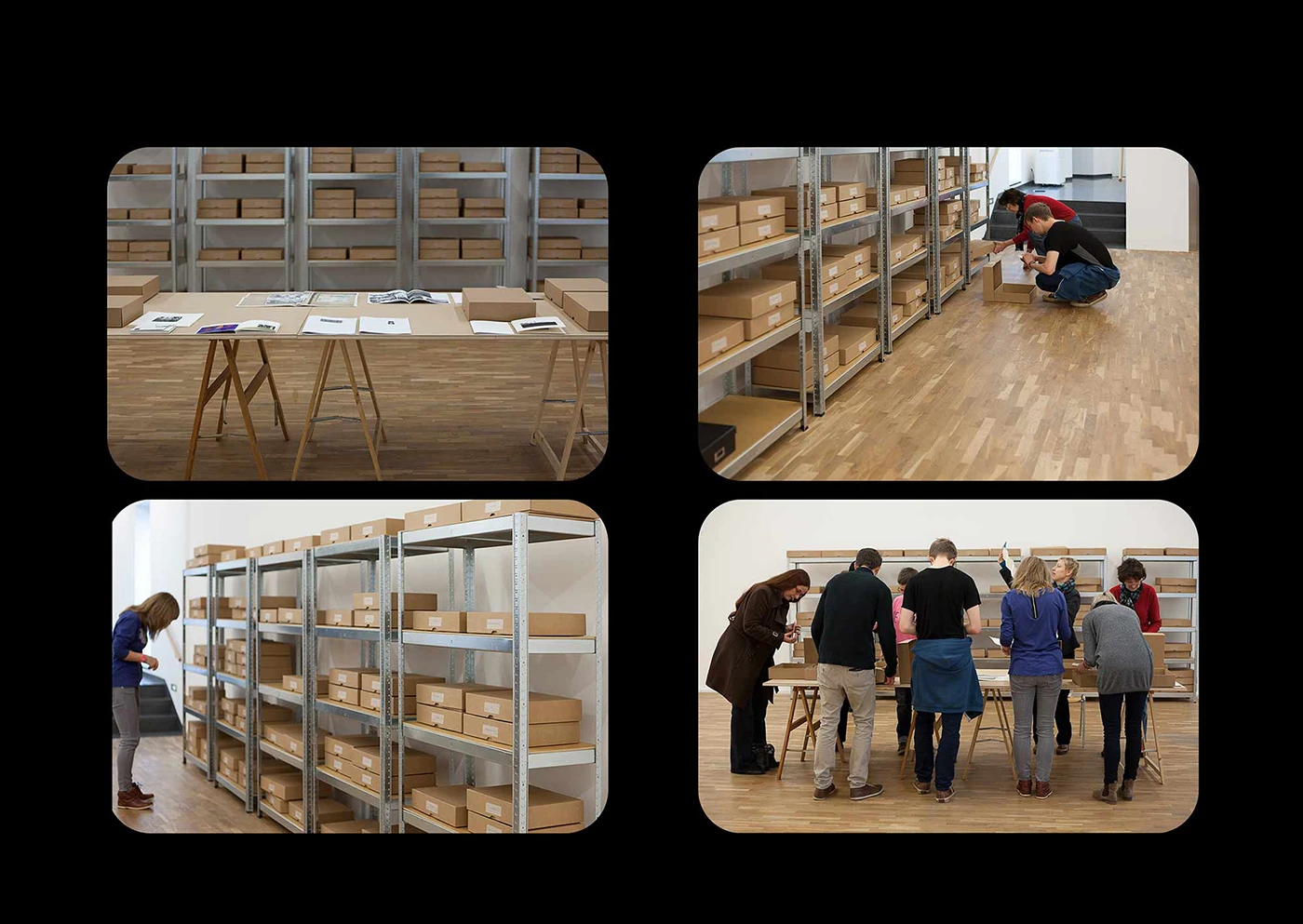
paula roush/ msdm mobile strategies of display & mediation
archive-table installation (2007–ongoing)
Installation and infra-institutional publishing framework presented at Dear Aby Warburg: What Can Be Done with Images? Dealing with Photographic Material
Museum für Gegenwartskunst Siegen, 2012–2013
Counter-Infrastructures name emergent practices that operate alongside, beneath, and across existing institutions, without seeking to replace them or to stabilise as new authoritative forms. They arise from lived conditions of precarity, care, and interdependence, and work by redistributing attention, resources, and responsibility where institutional infrastructures extract, exclude, or fail.
Counter-Infrastructures begin from the recognition of Living as Infrastructure: the understanding that life itself — bodies, time, affect, care, presence — already sustains cultural and institutional systems, often invisibly and at great cost. Rather than continuing to exhaust this condition, counter-infrastructural practices seek to acknowledge, protect, and re-organise it, making visible the labour that holds things together.
One way Counter-Infrastructures take form is through a Portable Infrastructure: an infrainstitutional structure that moves through publications, tables, walks, archives, workshops, and situated encounters. This portable infrastructure does not accumulate permanence, authority, or scale. Instead, it assembles temporary conditions for thinking, learning, and caring together, adapting to context and dissolving once its task is complete.
As a methodology of action, Counter-Infrastructures are editorial, pedagogical, and relational. They privilege slowness over acceleration, continuity over productivity, and maintenance over innovation. They operate through proximity, listening, and repetition rather than spectacle or growth. Publishing becomes an expanded spatial practice; mediation becomes an ethics of care; research becomes relation rather than extraction.
Counter-Infrastructures do not offer a finished model or a blueprint for reform. They function as speculative and situated tools — rehearsals for institutions-to-come — held open through practice, iteration, and collective responsibility. They inhabit the present while gesturing toward an otherwise: not a distant utopia, but a livable future imagined from within shared conditions of vulnerability and care.
Bio
I am an artist and researcher working across photography, publishing, installation, and computational practices. My work investigates how images, archives, bodies, and technologies are co-produced within situated ecologies.
Through msdm — mobile strategies of display & mediation, I develop editorial and artistic projects that understand publishing not merely as a format, but as a methodology: a space for encounter, listening, and the collective production of knowledge.
My practice is informed by hydropheminist, neo-materialist, and decolonial approaches, and engages with ruins, forgotten infrastructures, urban ecologies, and marginal archives. I often work through slow, relational, and autoethnographic practices, integrating walking, fieldwork, botany, found archives, and experimental photographic processes.
I integrate artificial intelligence and creative computational practices as a sensitive extension of my editorial work, approaching code as a space for experimentation, care, and continuity.
Institution(ing)s is a medium-scale collaboration project co-funded by the European Union. Views and opinions expressed are however those of the author(s) only and do not necessarily reflect those of the European Union or the European Education and Culture Executive Agency (EACEA). Neither the European Union nor EACEA can be held responsible for them.