ARTIST STUDIO AS A SITE OF REFUSAL
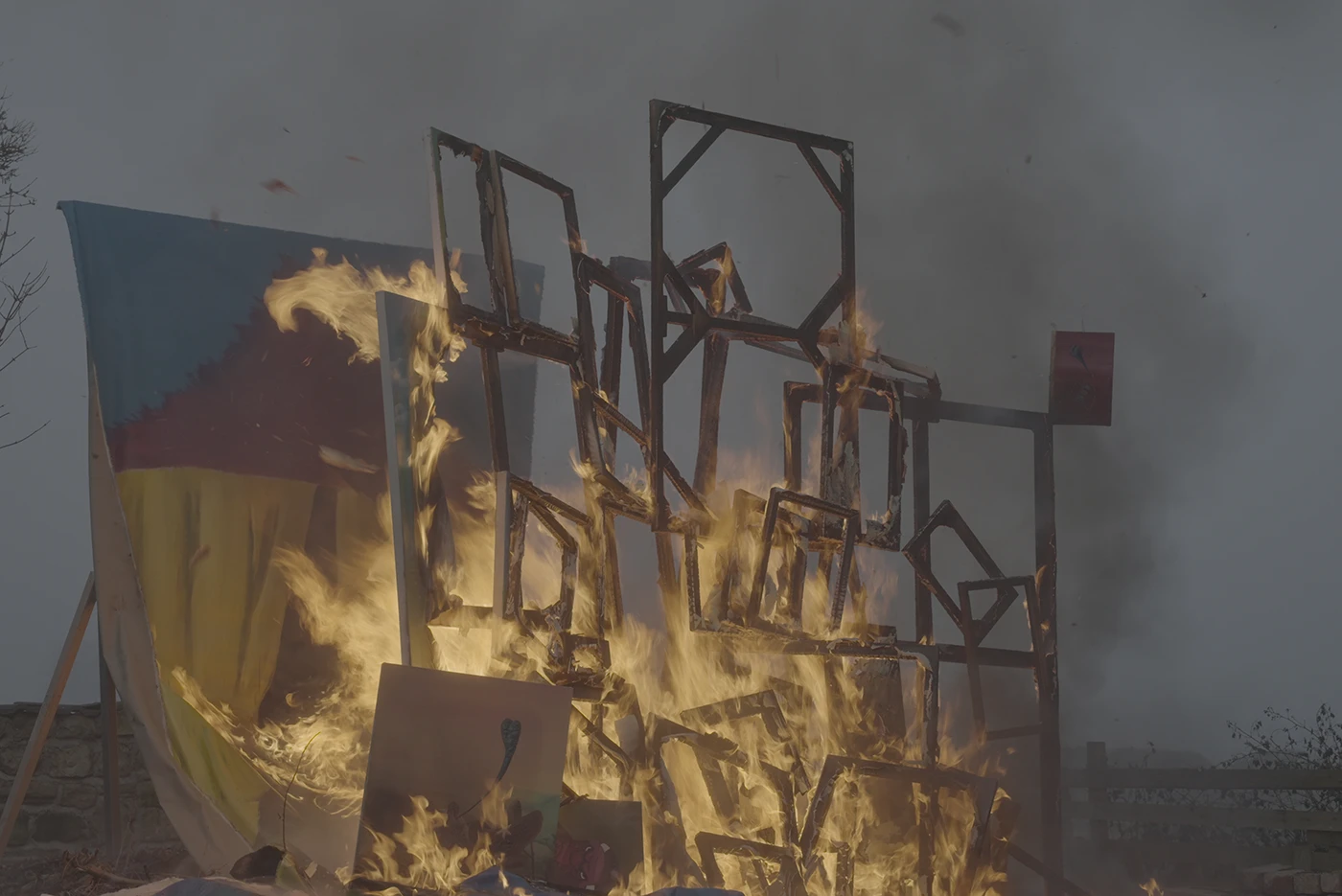
This submission proposes ARTIST STUDIO AS A SITE OF REFUSAL as a glossary-object: a book that generates meaning through material refusal rather than descriptive definition. The publication is based on the film THE SIGHT IS A WOUND (2025), which documents the burning of over fifty paintings and the transformation of the artist studio from a site of production into a forensic environment.
Film reference (for contextual grounding only)
Rather than functioning as an artist book, catalogue, or documentation, the zine operates as a condensed glossary of operational concepts that emerge when image-making becomes ethically untenable under conditions of continuous, live-streamed violence and institutional normalization. The film constitutes the originating rupture; the book functions as its semantic residue.
Book reference (glossary-object)
Artist Studio as a site of Refusal by Parham Ghalamdar
Each glossary term—such as Refusal (Material), Image Exhaustion, Ethics of Non-Addition, and End of Contemporary Art (Operational)—is articulated not through abstract definition alone, but through forensic presentation. Ashes, unburnable images, black-and-white printing, and clinical layouts operate as semantic devices rather than aesthetic choices.
The publication refuses to add new images to an already saturated visual economy. Instead, it catalogues what remains once production is suspended. In this sense, the glossary is evidentiary rather than illustrative: meanings are derived from what cannot continue.
Submitted to Institutionings, this glossary-object treats language, material, and institutional form as inseparable, asking whether concepts can still be generated without reinforcing the systems they attempt to critique.
Bio
Parham Ghalamdar is a multidisciplinary artist working across film, writing, and post-productive studio practices. His work examines the collapse of image-making, authorship, and artistic production under political, ecological, and computational pressure. Drawing on cybernetics, speculative theory, and material refusal, his practice investigates how systems of visibility, simulation, and institutional normalization shape what can still be seen, made, or justified.
Ghalamdar’s recent work has focused on the ethical limits of contemporary art in the context of live-streamed violence and cultural complicity. In 2025, he directed The Sight is a Wound, an experimental film structured as a refusal of image-making, in which over fifty of his own paintings were burned as a “funeral for the image.” The project extends beyond film into writing and studio-based forensic practices that prioritize residue, absence, and suspension over production.
His work has been shown internationally across art and film contexts, and is held in public collections including the Government Art Collection (UK). He is currently a scholarship recipient at The New Centre for Research & Practice and is developing further writing and film projects concerned with refusal, institutional form, and the exhaustion of representation.
Institution(ing)s is a medium-scale collaboration project co-funded by the European Union. Views and opinions expressed are however those of the author(s) only and do not necessarily reflect those of the European Union or the European Education and Culture Executive Agency (EACEA). Neither the European Union nor EACEA can be held responsible for them.