Instituent Glyphs
Instituent Glyphs
Instituent Glyphs
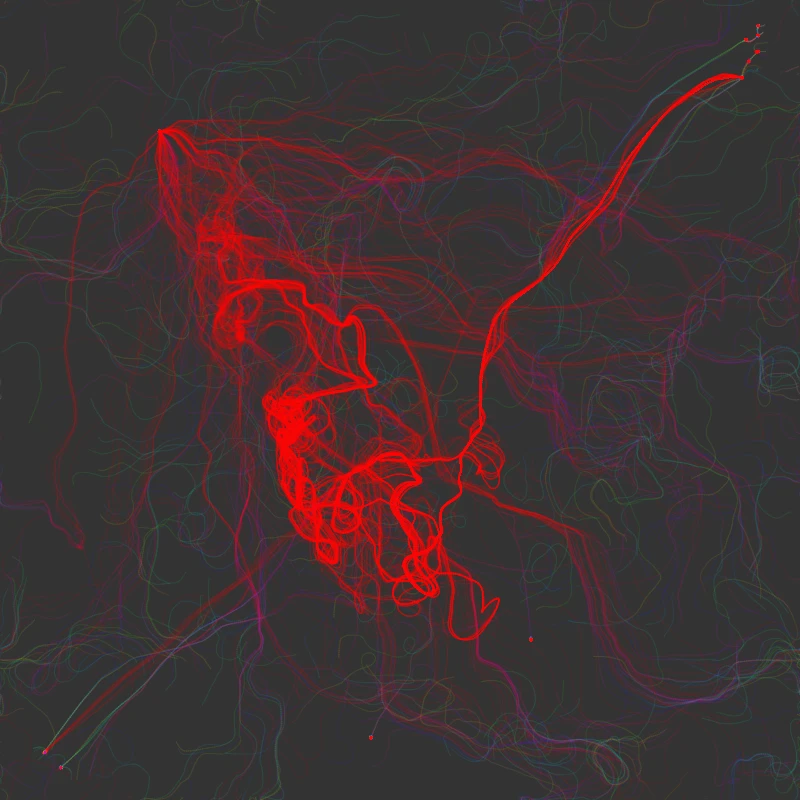
This sketch explores creativity as a distributed language, one that emerges not from a single author, but from the iterative dialogue between human intention and algorithmic chance.
Built in an open, community-driven process, it visualises how code becomes a space of collective expression. The piece embodies an idea central to Building Creative Machines: that art made with and through computation can expand our notions of authorship, collaboration, and imagination.
Collective Orbit
Collective Orbit
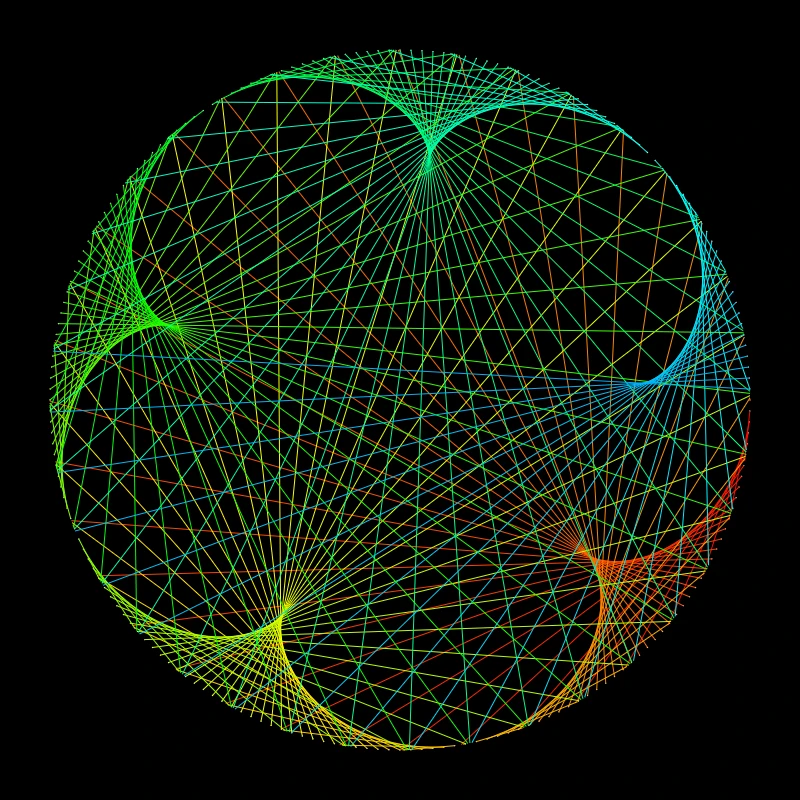
This image traces a network of relations wrapped into a circular topology, where lines stretch, fold, and reconnect across a shared boundary. Each segment suggests a local decision—an instruction, a rule, a gesture—yet the whole emerges as a continuous field of tension and cooperation. The work visualises how distributed agents, whether human or computational, co-produce structure through constraint and repetition. The apparent symmetry is constantly disrupted by subtle deviations, revealing a system that is neither fixed nor random, but negotiated in real time. As a glyph, it represents collective coherence: a form held together not by central control, but by ongoing interaction.
Phase Memory
Phase Memory
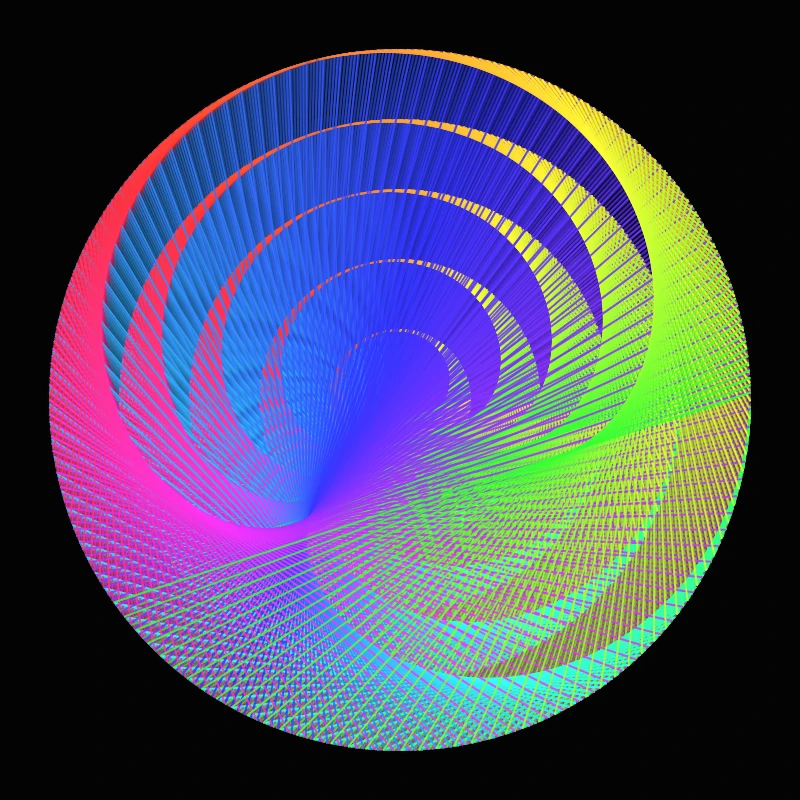
A spiral of colour and density unfolds toward a vanishing centre, suggesting motion, accumulation, and transformation over time. The gradient encodes a passage through states—each layer a trace of previous iterations, each line a memory of the system’s evolution. The image evokes a feedback loop where outputs become inputs, generating a continuous flow rather than discrete steps. It reflects on computation as a temporal medium, in which processes are not only executed but also sedimented. As part of a broader language, this glyph speaks to recursion and memory: how creative systems learn, adapt, and carry forward the imprint of their own becoming.
Polyphonic Field
Polyphonic Field
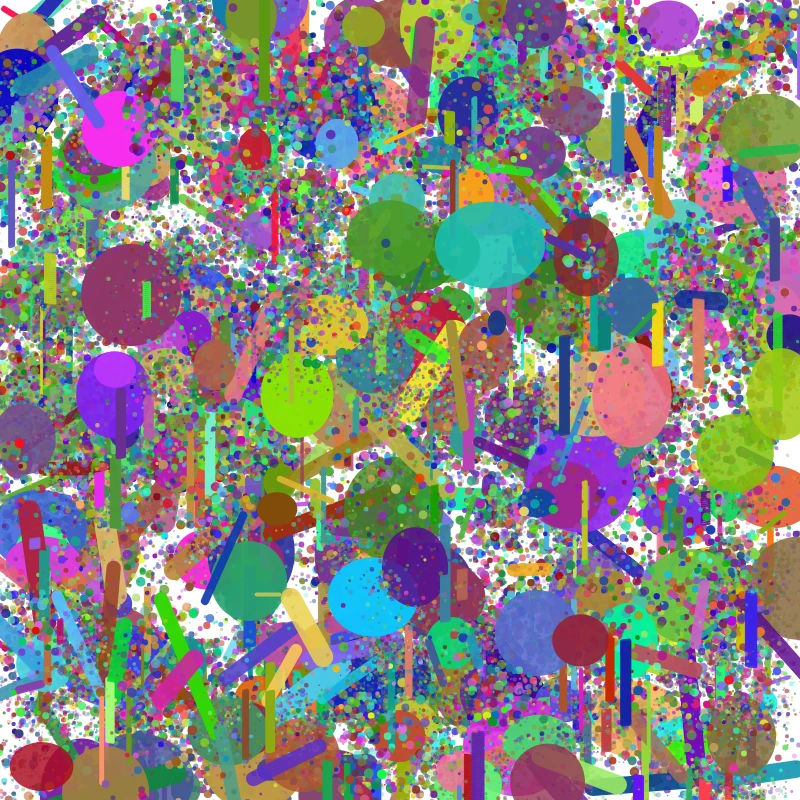
This dense aggregation of shapes and marks appears chaotic at first glance, yet reveals a layered composition of overlapping signals. Circles, lines, and particles coexist at varying scales and levels of transparency, forming a visual polyphony in which no single element dominates. The image foregrounds noise not as interference, but as a generative condition—an essential component of variation, discovery, and emergence. It mirrors collaborative environments where multiple voices, inputs, and intentions intersect without full alignment. As a glyph, it represents multiplicity: a system that resists simplification and instead thrives on the richness of simultaneous contributions.
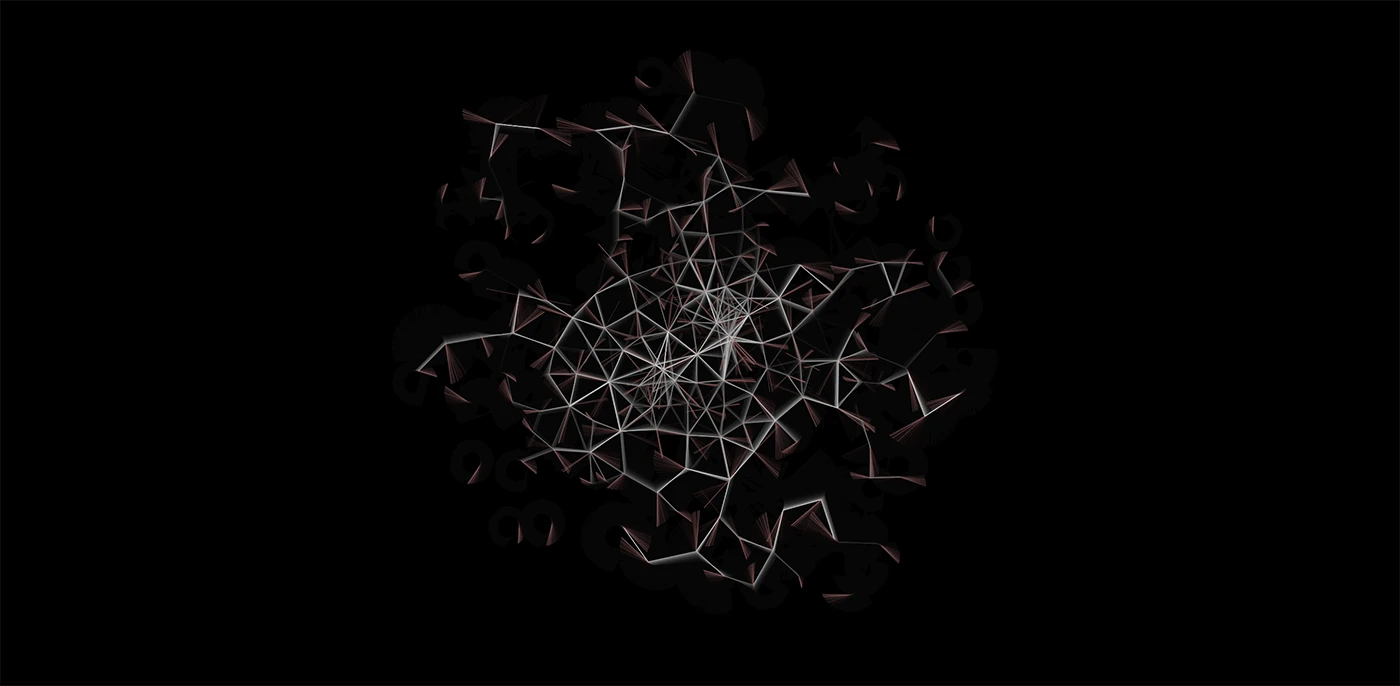
Emergent Scaffold
Emergent Scaffold
A sparse network of lines and nodes hovers in a dark field, suggesting the remnants or skeleton of a larger system. Connections appear tentative, as if continuously forming and dissolving, revealing the instability inherent in generative structures. The mesh does not describe a fixed object but an evolving topology—one shaped by proximity, interaction, and decay. This work reflects on the infrastructures that underlie creative computation: often invisible, provisional, and in flux. As a glyph, it points to emergence through subtraction, where what remains is not absence but potential—a scaffold for future relations to take form.
Bio
Gonçalo Perdigão
I am a creative technologist based in Lisbon, Portugal, working at the intersection of art, computation, and participatory design. Through Building Creative Machines, I aim to make creative technologies accessible and to encourage critical reflection on the cultural and aesthetic implications of machine creativity.
Institution(ing)s is a medium-scale collaboration project co-funded by the European Union. Views and opinions expressed are however those of the author(s) only and do not necessarily reflect those of the European Union or the European Education and Culture Executive Agency (EACEA). Neither the European Union nor EACEA can be held responsible for them.