Ex voto
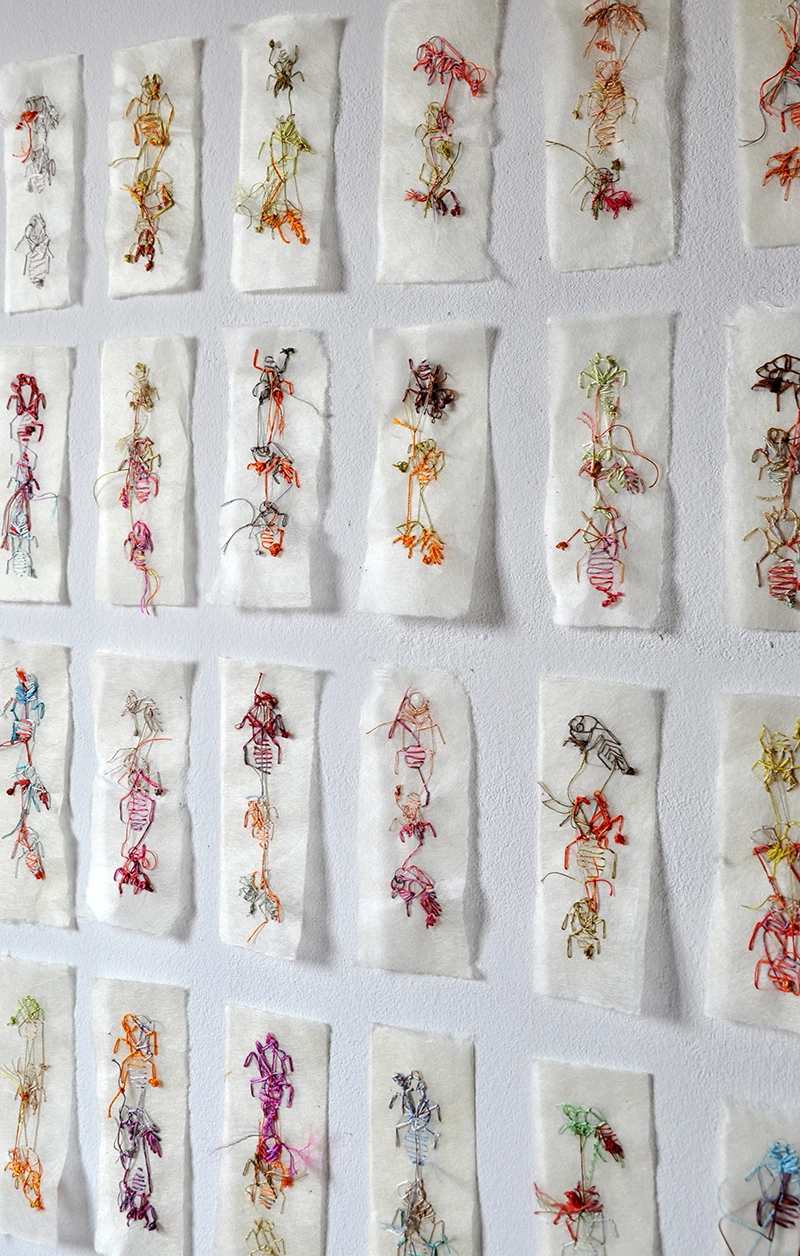
EX VOTO
embroidery on silkpaper
unsettled dimensions (every element about 7 x 18 cm)
2009-2011-2014
Rosetta Stone, was found in 1799 and decoded in 1822 by Jean François Champollion. Thanks to the translation of the same ancient text, a Ptolemaic edict in Greek, Demotic (popular Egyptian script) and Hieroglyphics, it was finally possible to decipher the linguistic system of Ancient Egypt, that mixed pictograms and phonograms.
Before that discovery, Egyptian was a mystery lost in time, as mysterious is the language of other beings. Plants communicate thanks to electric, physical and chemical signals (Wood Wide Web), birds emit complex social sounds with dialects, individual performances, inventive and sophisticated codex. The bee dance is used by foraging bees to give spatial, qualitative and quantitative informations through circular movements. We can communicate with our dog and understand our cat, but, unlucky, we don't have something like a Rosetta Stone or Dr Dolittle's super power. Among the other species, I would like to know more about the love songs of cicadas, that in China and in the Mediterranean area were associated to resurrection and rebirth, often in funerary contexts, as once Egyptian mummies were to immortality. These insects, in facts, spend several years underground as larvae. Then, they emerge into the sunlight, stiffen their external exoskeleton, reconfigure their internal organs, and fly away, abandoning the form that has protected them for years. The remains (exuvia) consist of a golden casing, as thin as a hair, which shows the nymphal shape and the position assumed during the moult, while the upper part appears divided in two by the furrow where the adult insect emerges Ex voto (2009-2011-2014), with its embroideried strips of cicada exuviae similar to pictograms, symbolizes the prayer for individual and collective psychophisical change, a difficult period of mutation and apparent stasis, anticipation of a resplendent flight into the sun of brief maturity.
Bibliography
- Jennifer Ackerman, La vita segreta degli uccelli. Come amano, lavorano, giocano e pensano, translation from English by Milena Zemira Ciccimarra, La nave di Teseo, Trebaseleghe, May 2021
- Bert Holldobler, Edward O. Wilson, Il Superorganismo. Bellezza, eleganza e stranezza delle societa?egli insetti, illustrations by Margaret C. Nelson, translation from English by Isabella C. Blum, foreword by Donato A. Grasso, Biblioteca Scientifica Adelphi Edizioni, Lavis 2011
- Stefano Mancuso, Alessandra Viola, Verde Brillante. Sensibilita? intelligenza del mondo vegetale, Giunti, Prato 2013
- Merlin Sheldrake, L'ordine nascosto: La vita segreta dei funghi, translation from English by Anita Taroni and Stefano Travagli, Marsilio, Giangiacomo Feltrinelli Editore Milano, Trebaseleghe 2022
Bio
Giulia Berra is an Italian visual artist. She was born on the 3rd of April 1985 in Cremona (Italy), where she lives and works From 2022 to 2025 she was professor of Artistic Anatomy at Accademia Albertina di Belle Arti di Torino, Turin. She exposes in group and solo exhibitions in Italy and abroad, developing projects deeply connected with landscape, architecture and historic context. Nature is the starting point to make utopian visions and metaphors about the contemporary period. She studies processes, biological cycles and their interactions, their limits. Her artistic research deals mainly with natural leftovers and residual elements, usually found abandoned on the ground and patiently collected over several months, as insect wings, feathers, galls, chrysalises.
Institution(ing)s is a medium-scale collaboration project co-funded by the European Union. Views and opinions expressed are however those of the author(s) only and do not necessarily reflect those of the European Union or the European Education and Culture Executive Agency (EACEA). Neither the European Union nor EACEA can be held responsible for them.