Ripping Footnotes
What are you listening to?
The recording you are listening to is a sound piece composed with field recordings of the workshops hosted through Ripping Footnotes.
Ripping Footnotes was a series of public space initiatives and a platform for artistic research by Dora Ramljak and Cecilie Fang dated back to 2023.
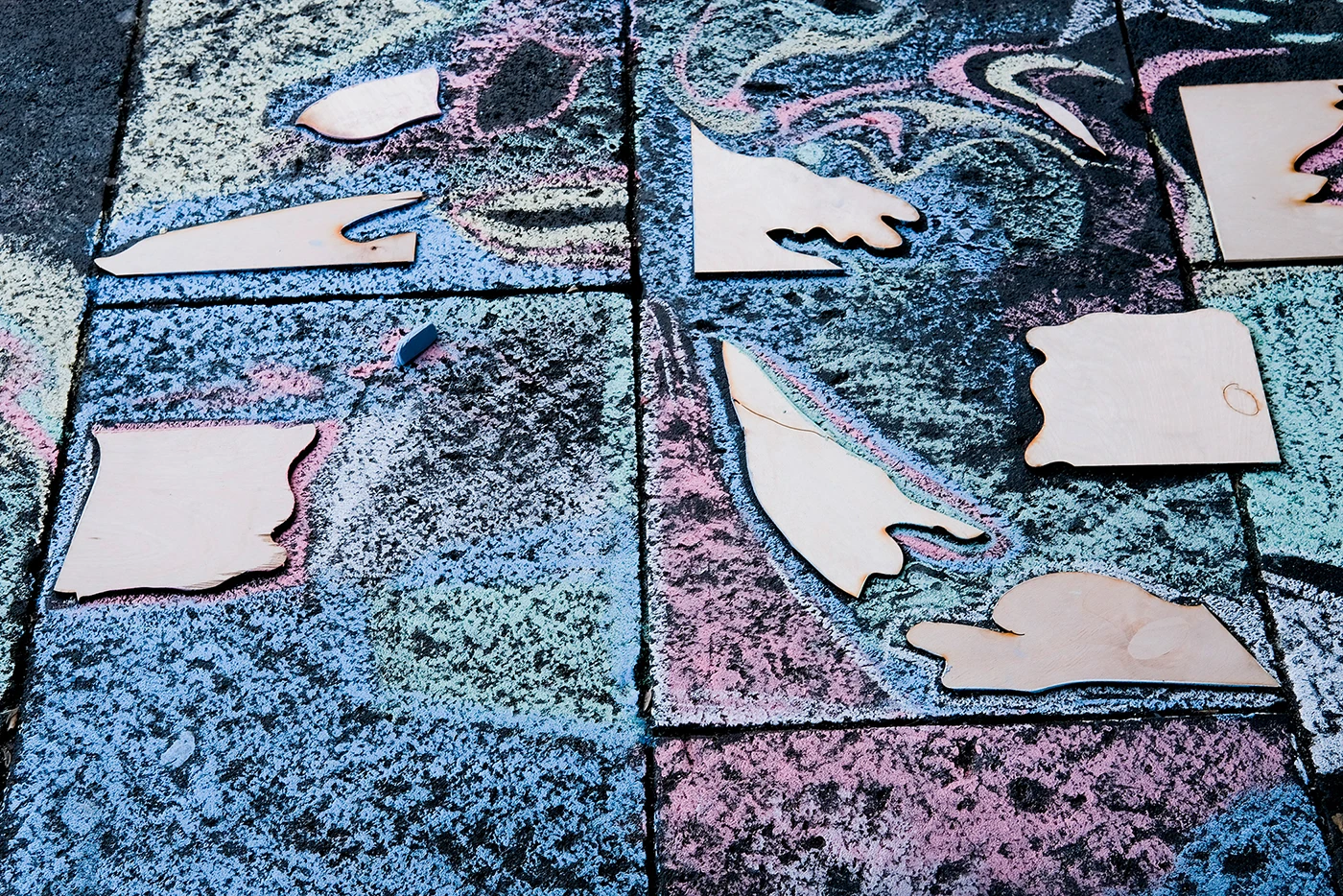
The workshop(s) became a space for mutual learning and decentralizing how institutional education is centered around hierarchy; learning from top-down, shaped for able-bodied bodies. Ripping Footnotes was a space for artistic research in its presence and after digestion through dialogue. The focus on re-sensing urban space became a method of deinstitutionalizing care and learning in the form of public drawing and sound workshops. Each workshop was centered around listening as a method of caring and drawing as a method of slowing down. Play became a purposeful space for resistance to rethink learning as a fluid process without one fixed origin or end.
Through the year of 2023, we hosted di erent workshops with Stichting de Vrolijkheid and Atelier Kunstvlieg among others, where we drew, listened, and researched together.
Bio
Dora Ramljak (b. Croatia) and Cecilie Fang (b. China/Denmark) are artists based in the Netherlands whose practices meet in the project titled ‘Ripping Footnotes’ from 2023.
Dora is a trans-disciplinary artist with a background in photography and design, and a graduate of the Royal Academy of Art in The Hague. Her work explores art’s role in questioning institutionalized orders of learning and sensing. She has collaborated with psychiatric hospitals and research centers to design sensory therapy tools for marginalized communities, approaching art as a platform for sustainable and socially engaged solutions. Currently, she is expanding her research in philosophy, design, and biomaterials.
Cecilie is an anti-disciplinary artist and writer whose process-oriented work unfolds across performance, publication, installation, and material micro-performativity. Rooted in her upbringing between Mandarin, English, and Danish, her practice is an ongoing auto-ethnographic inquiry into language, translation, and access. Through speculative forms of writing and languaging, she explores how meaning is produced, fails, and can be reimagined outside dominant linguistic norms.
Together, their practices intersect in an interest in rethinking forms of communication, sensing, and collectivity.
Institution(ing)s is a medium-scale collaboration project co-funded by the European Union. Views and opinions expressed are however those of the author(s) only and do not necessarily reflect those of the European Union or the European Education and Culture Executive Agency (EACEA). Neither the European Union nor EACEA can be held responsible for them.